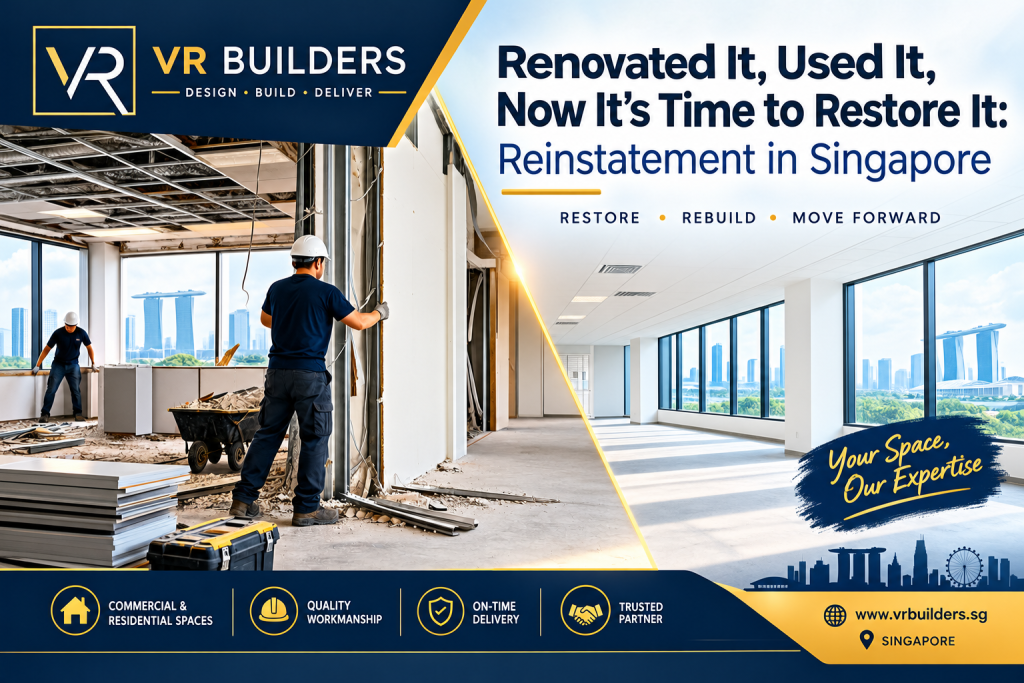
Renovated It, Used It, Now It’s Time to Restore It: Reinstatement in Singapore
A few years ago, your team moved into a bare unit and made it your own. Glass meeting rooms went up, a pantry was built, carpet went down and the reception got a feature wall with the company logo. It worked well. Now the lease is ending, and most of that has to come out again.
This is the part of the office lifecycle that rarely gets planned for. The fit-out had a designer, a budget and a timeline. The exit often has none of these until the landlord asks. This guide covers what office reinstatement in Singapore involves, what tends to go wrong, and how to hand back your space without last-minute stress.
What Is Office Reinstatement?
Office reinstatement is the process of removing a tenant’s fit-out and restoring the premises to the condition agreed in the lease. For many commercial units in Singapore, that means returning the space to its original or bare shell condition before handover.
The same applies to retail shops, F&B outlets and industrial units; only the scope changes. A retail unit may have a shopfront and display fixtures to remove, while an office may have partitions, raised flooring and cabling.
Why Is Reinstatement Required When a Commercial Lease Ends?
Reinstatement is usually required because the tenancy agreement says so. Landlords want a unit they can lease to the next tenant, who will likely have different layout needs.
The specific requirements vary between landlords, buildings and leases. Some ask for full removal down to bare shell. Others may accept certain items, such as ceilings or lighting, if they’re in good condition or the incoming tenant wants them. Any such arrangement should be confirmed in writing with the landlord or building management.
Check Your Lease Early
Before speaking to any contractor, find these documents:
- The reinstatement clause in your tenancy agreement
- The condition report, photos or floor plan from when you took over the unit
- Approved fit-out drawings from your original renovation, if available
- The building’s fit-out or works guidelines
Together, they tell you what the unit looked like before you moved in and what you’ve changed since. Without them, the scope becomes a matter of opinion.
What Does Office Reinstatement Usually Include?
Office reinstatement usually includes removing tenant installations and making good the walls, floors and ceilings affected by them. The exact scope depends on your fit-out and the lease terms.
Removal works
- Partitions, glass panels, internal doors and feature walls
- Built-in cabinetry, reception counters and pantry fittings
- Raised floors, carpets, vinyl or other added floor finishes
- Signage and branding elements
Electrical, plumbing and other services
- Removing or capping additional power points, lighting and data cabling
- Removing pantry sinks and related piping, where applicable
- Reverting air-conditioning or other services that were modified, where the lease requires it
Restoration and making good
- Patching holes, skim coating and repainting walls
- Reinstating ceilings to the original layout or specification
- Repairing floor screeds or surfaces exposed after removal
Clearing and handover preparation
- Removing debris and unwanted installations
- Final cleaning so the unit is ready for inspection
If your original fit-out involved structural changes, such as openings in walls or a mezzanine, reversing them may need to be handled as addition and alteration works, with structural input.
When Should Businesses Start Planning Reinstatement?
Start planning once you know you’re leaving, well before the lease expiry date. There’s no fixed lead time that suits every unit, because the scope ranges from a light strip-out to a full floor restoration.
Early planning gives you time to agree the scope with the landlord, compare quotations, arrange access with building management and still leave a buffer for rectification after the inspection. It also helps if you’re fitting out a new office at the same time.
Common Mistakes Tenants Make
- Assuming the scope. Guessing what the landlord wants instead of confirming it.
- Starting too late. Leaving no time for delays or rectification.
- Choosing on price alone. Low quotes sometimes exclude items like debris disposal or making good.
- Forgetting building rules. Work permits, noisy-work hours and loading bay bookings can vary between buildings.
- Skipping the pre-inspection. Walking the unit with the landlord before works start can prevent disputes later.
How Do I Choose a Reinstatement Company in Singapore?
Choose a reinstatement company in Singapore that has commercial experience, visits the site before quoting and gives you an itemised scope. Beyond that, look for:
- Experience with offices, retail or industrial units similar to yours
- A quotation that lists every item and states what’s excluded
- The ability to coordinate hacking, M&E, ceiling, flooring and painting works
- Familiarity with landlord inspections and building management procedures
- A realistic schedule that works back from your handover date
- One clear point of contact
Why an Experienced Reinstatement Contractor Helps
Many reinstatement problems come down to sequencing and communication. An experienced reinstatement builder in Singapore knows which trades go first, what inspectors typically look at and how to work within building rules. That reduces the chance of items being missed or redone.
VR Builders provides commercial reinstatement services in Singapore for office, retail and industrial units. The team confirms the original condition against the tenancy agreement, handles works such as hacking, patching, repainting, ceiling and floor reinstatement, M&E removal and site clearance, and coordinates with building management through to the joint inspection. You can see an example in this case study on commercial, retail and F&B reinstatement.
If you’re planning a fit-out for your next premises, it’s worth thinking about reinstatement from the start. Choices made during office and commercial renovation affect how much work the eventual exit will need.
Frequently Asked Questions
What is office reinstatement in Singapore?
It is the removal of a tenant’s fit-out and the restoration of a leased office to the condition required in the tenancy agreement, often bare shell, before handover.
Is reinstatement always required when a lease ends?
Not always to the same extent. It depends on the lease terms and the landlord. Some require full removal, while others may accept certain items. Confirm the requirements in writing.
What is the difference between reinstatement and renovation?
Renovation adds or changes fittings to suit a tenant. Reinstatement removes those changes and restores the unit for handover.
Can I leave some fixtures behind for the next tenant?
Possibly, but only with the landlord’s written agreement. Without it, you may be responsible for removing them or paying for their removal.
How long does commercial reinstatement take?
It depends on the size of the unit, the amount of fit-out, building access rules and any rectification needed. A contractor can give a schedule after a site visit.
What should a reinstatement quotation include?
Each item of removal and restoration work, materials for making good, debris disposal, cleaning, exclusions and the proposed schedule.
Handing Back Your Space
Your fit-out served its purpose. Reinstatement is simply the final stage of that lifecycle, and it goes much more smoothly with a clear scope, early planning and a contractor who understands commercial handovers.
If you’re preparing to vacate a commercial space, you can explore VR Builders’ reinstatement services and arrange a site assessment to understand what your unit will need.